
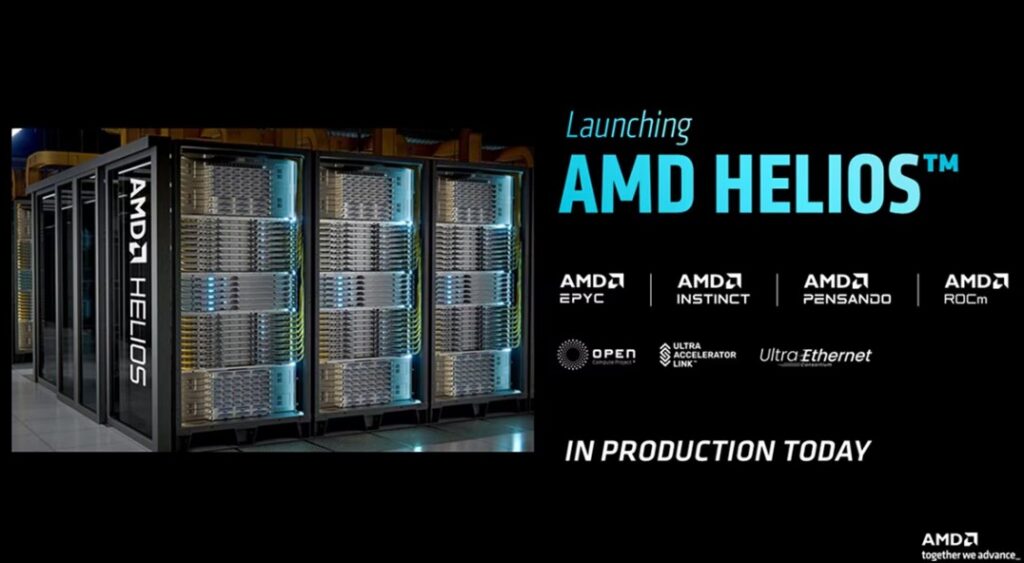
The newly launched AMD Helios server rack, featuring a unified 72-GPU architecture, liquid-cooled CDNA 5 Instinct MI455X accelerators, and Zen 6 “Venice” CPUs designed for frontier AI workloads.
Meta Description: Explore AMD’s Helios server rack launch, Alphabet’s surprise earnings, Intel’s surge, and Naver-Dunamu deal concerns in today’s hot IT news.
Focus Keyword: Today’s key IT news
Slug: todays-key-it-news
In the ever-evolving landscape of the IT industry, today’s key news highlights events that are reshaping the market. AMD has introduced its cutting-edge ‘Helios’ server rack, which has set the stage for serious competition against NVIDIA. Meanwhile, Alphabet’s mixed earnings report raises questions about its AI investments, Intel’s impressive quarterly performance boosts its stock, and regulatory concerns cloud Naver’s acquisition plans. Here are the four most important updates you should know today.
AMD Unveils ‘Helios’ Server Rack to Compete with NVIDIA
At the ‘AMD Advancing AI 2026’ conference, CEO Lisa Su officially unveiled the ‘Helios’ server rack, designed to serve as a comprehensive stack of advanced hardware infrastructure. This powerful offering incorporates AMD’s latest 6GW AI accelerators and the sixth-generation Venice chips. The introduction of Helios positions AMD as a formidable challenger to NVIDIA, which has long dominated the AI hardware market. Companies like Meta are already adopting this new technology, potentially shaking NVIDIA’s grip on the sector.
The Helios server rack promises significant performance improvements and flexibility for businesses looking to enhance their AI capabilities. The competition between these tech giants is expected to intensify as enterprises seek to leverage AI more effectively in their operations. The implications of this rivalry might redefine AI deployment standards across various sectors, altering the current balance in the market.
Alphabet’s Earnings Surprise versus AI Investment Concerns
In a surprising turn, Alphabet, Google’s parent company, reported second-quarter revenues of $119.8 billion, exceeding analysts’ expectations. However, the company’s aggressive investment in AI infrastructure—estimated to be around 66 trillion won—resulted in a negative cash flow. This raised eyebrows among investors, leading to a drop in Alphabet’s stock value after the earnings release.
Despite the strong revenue, the decision to allocate a significant portion of funding toward AI initiatives has raised concerns among stakeholders. Investors are now questioning the sustainability of Alphabet’s cash management, especially when huge outlays don’t guarantee immediate returns. As AI technology becomes paramount, how Alphabet navigates these financial challenges will be critical for maintaining investor confidence.
Intel’s Q2 Performance and Stock Surge
In a stark contrast to Alphabet, Intel has reported a remarkable second-quarter performance, achieving an adjusted earnings per share (EPS) of $0.42 alongside revenues of $16.1 billion. This underperformance prompted an 11% jump in its stock during after-hours trading, showcasing resilience within a competitive market. The company’s data center AI momentum played a vital role in driving these impressive results.
Intel’s ability to harness AI-related demands is setting a new trajectory for its growth, and the marketplace is responding positively to these developments. Investors and analysts alike are keeping a close eye on how Intel will capitalize on its strengths to compete effectively against rivals like AMD and NVIDIA.
Regulatory Hurdles for Naver’s Acquisition of Dunamu
Amidst ongoing mergers and acquisitions in the tech sector, Naver’s attempt to acquire Dunamu, the operator of the Upbit cryptocurrency exchange, faces scrutiny. The company’s efforts are further complicated by the recent introduction of a revised regulatory framework under the Specific Financial Information Act. Naver is navigating a turbulent landscape, especially as its subsidiaries have faced legal challenges, including a recent conviction for violating antitrust laws.
These regulatory issues could pose significant barriers that might derail the acquisition plans. Stakeholders within the IT and finance sectors are observing how these developments unfold, as the consequences could impact market dynamics and future investment strategies in the cryptocurrency space.