
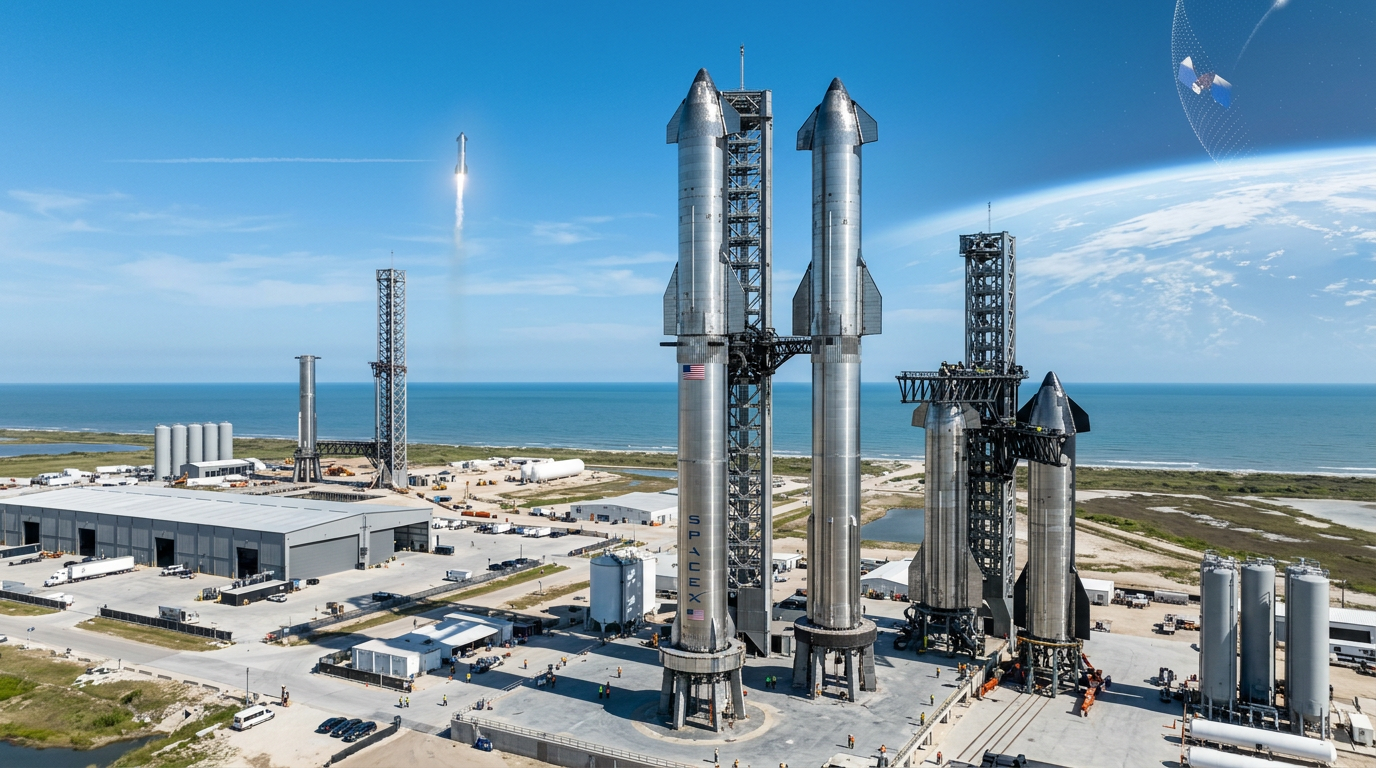
SpaceX: Pioneering the Future of Space Exploration in 2026
SpaceX, under the visionary leadership of Elon Musk, continues to redefine the boundaries of space exploration and technology. As of mid-2026, the company is not just a leader in rocket launches but a multifaceted enterprise pushing forward with ambitious projects ranging from global satellite internet to interplanetary travel. This article delves into the latest developments, key initiatives, and the anticipated impact of SpaceX’s relentless pursuit of innovation.
Starship: The Cornerstone of SpaceX’s Future
At the heart of SpaceX’s long-term ambitions lies Starship, a fully reusable, super heavy-lift launch vehicle designed to transport both crew and cargo to Earth orbit, the Moon, Mars, and beyond. In 2026, Starship development at Starbase, Texas, remains a primary focus. Significant strides have been made in testing, with multiple high-altitude flight tests and iterative design improvements becoming almost routine. The integrated flight tests of Starship and its Super Heavy booster have provided invaluable data, leading to refinements in engine performance, heat shield durability, and rapid reusability. The ability to refuel Starship in orbit is crucial for deep-space missions, and testing of orbital propellant transfer capabilities is ongoing, with significant progress expected by year-end.
Starship’s potential applications are vast. Beyond NASA’s Human Landing System (HLS) program for the Artemis missions to the Moon, SpaceX envisions Starship as the primary transport for its Mars colonization efforts. The sheer volume and mass Starship can deliver to orbit at a significantly lower cost per launch promise to revolutionize space logistics and make large-scale space infrastructure development feasible.
Starlink: Expanding Global Connectivity
SpaceX’s Starlink constellation, aiming to provide high-speed, low-latency internet globally, has seen phenomenal growth and technological advancements in 2026. With thousands of satellites now in low Earth orbit, Starlink’s coverage has expanded significantly, reaching remote and underserved areas across continents, including growing service in parts of Asia. The continuous deployment of new generations of satellites, featuring enhanced inter-satellite laser links and improved throughput, has bolstered the network’s capacity and reliability.
New user terminals, more compact and efficient, have also been introduced, making the service more accessible. SpaceX is actively exploring partnerships with telecommunication providers to integrate Starlink into existing networks, further broadening its reach. The company is also working on advanced applications of Starlink for commercial aviation, maritime, and defense sectors, demonstrating the versatility of its satellite internet infrastructure. The ongoing challenge of managing orbital debris is being addressed with advanced deorbiting capabilities built into each satellite and responsible constellation management practices.
Falcon Family: The Workhorses of Space Access
While Starship garners much attention for its future potential, the Falcon 9 and Falcon Heavy rockets remain the backbone of SpaceX’s launch operations in 2026. These reliable, reusable launch vehicles continue to set industry records for launch cadence and cost-effectiveness. Falcon 9, in particular, has become the world’s most frequently launched orbital rocket, serving a diverse clientele including commercial satellite operators, government agencies, and Starlink deployments.
The Falcon Heavy, with its immense payload capacity, continues to be the preferred choice for launching heavy scientific probes, national security missions, and large geostationary satellites. The reusability of Falcon boosters and fairings has become a standard operation, drastically reducing the cost of access to space and enabling numerous missions that might otherwise be economically unfeasible. SpaceX is continually refining the recovery and refurbishment processes, pushing the boundaries of rapid reusability and efficiency.
Advancements in Propulsion and Materials Science
SpaceX’s commitment to pushing technological boundaries extends to fundamental research in propulsion and materials science. The Raptor engine, powering Starship and Super Heavy, is a marvel of engineering, a full-flow staged combustion engine that is more efficient and powerful than its predecessors. Ongoing iterations of the Raptor engine aim to further increase thrust, improve reliability, and simplify manufacturing.
In materials science, SpaceX is investigating advanced alloys and composite structures for future spacecraft designs, focusing on lighter, stronger, and more heat-resistant materials crucial for atmospheric re-entry and deep-space environments. These advancements are not only critical for Starship but also for future iterations of its engines and ancillary systems.
Human Spaceflight and Beyond
SpaceX’s Crew Dragon capsules continue to be instrumental in transporting astronauts to and from the International Space Station (ISS) for NASA and private space tourism missions. With a proven track record, Crew Dragon remains a reliable and safe means of human space transportation. The company is also developing next-generation pressure suits and life support systems specifically designed for lunar and Martian environments, in anticipation of Starship’s future crewed missions.
The long-term vision of colonizing Mars remains a driving force for SpaceX. While a crewed mission to Mars is still several years away, the continuous development of Starship, coupled with advancements in life support and in-situ resource utilization (ISRU) technologies, brings this ambitious goal closer to reality. SpaceX is actively researching methods for extracting water and producing propellant on Mars, crucial steps for sustaining a human presence on the Red Planet.
FAQ
Q: What is SpaceX’s primary focus in 2026?
A: In 2026, SpaceX’s primary focus continues to be the rapid development and testing of its Starship launch system for interplanetary travel and the expansion of its Starlink satellite internet constellation globally.
Q: Has Starlink achieved global coverage in 2026?
A: Starlink has significantly expanded its coverage in 2026, reaching many remote and underserved areas worldwide. While not every single corner of the globe has active service, the network is extensive and continually growing, with new regions coming online regularly.
Q: What is the latest on Starship’s development?
A: Starship development in 2026 involves ongoing integrated flight tests of the full stack (Starship and Super Heavy), focusing on orbital refueling capabilities, rapid reusability, and refining the heat shield and engine performance for future lunar and Martian missions.
Q: How often does SpaceX launch rockets?
A: SpaceX maintains a very high launch cadence with its Falcon 9 and Falcon Heavy rockets, performing dozens of launches annually for a variety of government and commercial clients, in addition to its internal Starlink deployments.
Q: Is SpaceX still involved with NASA’s Artemis program?
A: Yes, SpaceX is a key partner in NASA’s Artemis program. Starship has been selected as the Human Landing System (HLS) for landing astronauts on the Moon as part of the Artemis missions, with significant development efforts underway to meet program milestones.
Conclusion
SpaceX in 2026 is a company operating at the vanguard of aerospace innovation, demonstrating unparalleled ambition and execution. From the reusable marvels of the Falcon family to the revolutionary Starship, and the global reach of Starlink, SpaceX is fundamentally changing how humanity accesses and utilizes space. The ongoing advancements in propulsion, materials, and operational efficiency are not merely incremental improvements but foundational shifts that pave the way for a multi-planetary future. As the company continues its rapid pace of development and testing, its impact on science, technology, and human civilization is poised to grow exponentially in the years to come, solidifying its position as a true pioneer in the 21st century space race.