
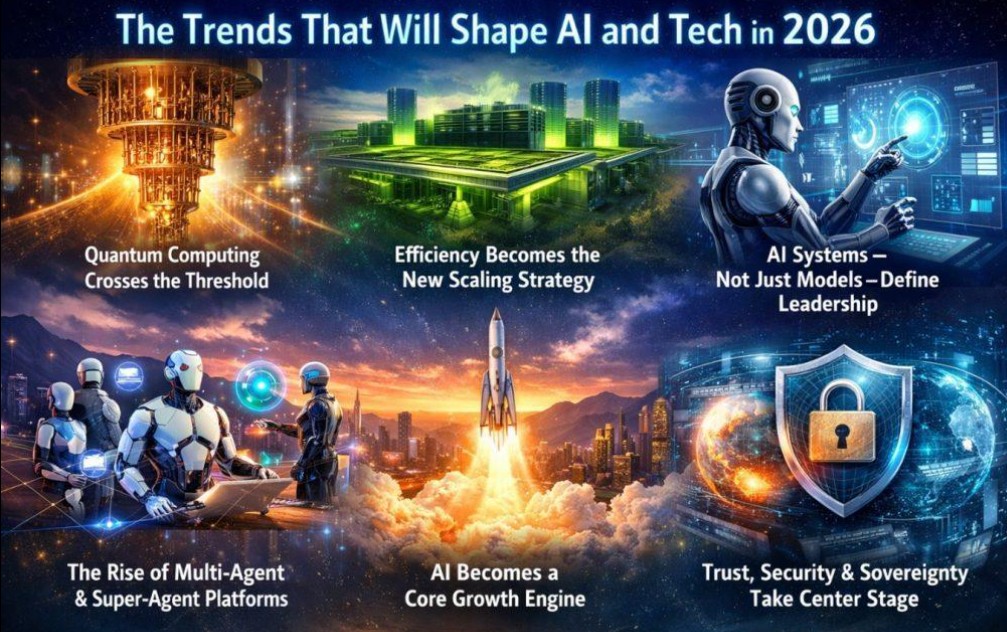
Artificial intelligence, robotics, and smart city technologies are reshaping urban environments and driving the next era of digital economic growth.
Meta Description: As AI continues to evolve, 2026 promises significant shifts in tech landscapes, compelling businesses to adapt or fall behind.
Focus Keyword: AI advancements in 2026
As we approach 2026, artificial intelligence (AI) is on the cusp of transformative changes that will reshape industries and economic models. Recent developments in generative AI and machine learning algorithms are positioning businesses to harness unprecedented efficiencies and innovation. Companies that fail to adapt risk being left behind in a rapidly advancing tech landscape, making an understanding of current AI trends crucial for stakeholders.
The urgency for organizations to understand these shifts stems from the need for competitive advantage and operational resilience. From enhancing productivity to enabling smarter decision-making, AI advancements present both opportunities and challenges that are imperative for modern businesses to navigate.
Current Trends in AI Advancements for 2026
Recent reports indicate a meteoric rise in AI-driven applications, particularly in sectors such as healthcare, finance, and supply chain management. Many companies have begun integrating AI systems not merely for automation but also for strategic insights. For instance, numerous healthcare providers are utilizing AI to analyze patient data, thereby improving diagnostic accuracy. Leading firms like Google and Microsoft have released new AI models that not only process data faster but also generate predictive analytics, a game-changer in risk assessment.
Moreover, generative AI technologies, particularly in natural language processing, are evolving rapidly. OpenAI’s ChatGPT has set a new standard, enabling businesses to enhance customer service through advanced chatbots. Such implementations are not only boosting engagement but also significantly reducing operational costs. As we head toward 2026, the role of AI in delivering personalized user experiences will become paramount, compelling businesses to rethink customer interaction strategies.
Impact of AI Advancements on Business Operations
The influence of AI on business operations is profound, particularly in driving efficiency and innovation. As automation technologies gain traction, industries such as manufacturing stand to benefit from reduced human error and optimized production processes. Companies like Tesla are already integrating AI in their manufacturing lines to streamline operations and enhance quality control.
Furthermore, the data-driven approach that AI facilitates empowers businesses to make informed decisions. By analyzing vast datasets, organizations can identify trends and patterns that lead to more effective marketing strategies and product development. However, this transition comes with its own set of challenges, particularly around data privacy and security, requiring businesses to adopt robust cybersecurity measures to protect sensitive information.
Future Outlook: Why AI Will Reshape Business Landscape by 2026
Looking ahead, the potential applications of AI are almost limitless. Analysts predict that by 2026, companies that successfully adopt advanced AI techniques will realize substantial gains in productivity and market share. The focus will likely shift towards ethical AI and responsible innovation, with organizations prioritizing transparency and fairness in AI deployment.
From an investment perspective, the importance of staying abreast of AI advancements cannot be overstated. Investors are increasingly looking towards tech companies that demonstrate a strong commitment to AI integration as indicators of future growth. Overall, as businesses gear up for 2026, the onus will be on them to evolve in alignment with AI’s trajectory, ensuring they are equipped to leverage its potential while mitigating inherent risks.
Frequently Asked Questions
What are the key AI advancements to expect in 2026?
In 2026, significant advancements are anticipated in areas like generative AI, natural language processing, and predictive analytics. Businesses will leverage these technologies for improved customer engagement and operational efficiencies, making them crucial for competitive advantage.
How can businesses prepare for AI changes in 2026?
Businesses can prepare by investing in AI training and technology integration, fostering a culture of innovation, and prioritizing data security. Staying informed about current trends will also be fundamental for adaptation and strategic planning.
What are the risks associated with AI advancements?
While AI presents numerous benefits, it also carries risks, particularly regarding data privacy and ethical considerations. Businesses must implement stringent cybersecurity measures and ensure transparency in their AI applications to mitigate these risks effectively.