
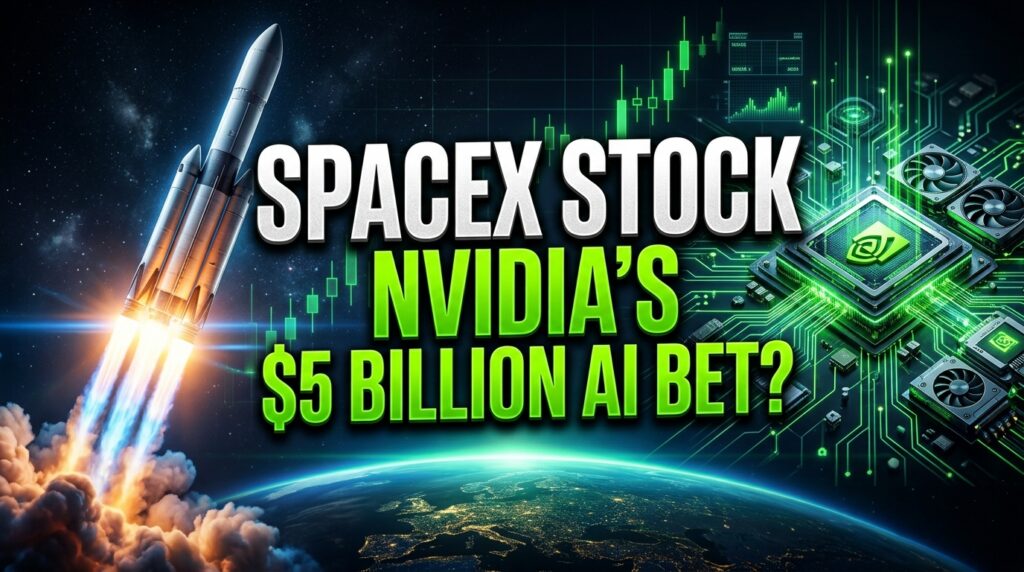
SpaceX’s growing AI ambitions and its reported financial relationship with Nvidia are attracting investor attention as demand for AI infrastructure continues to expand.
SpaceX Stock (SPCX): Is Nvidia’s AI Infrastructure Boom a Buying Opportunity?
SEO Meta Description: SpaceX (NASDAQ: SPCX) is expanding into AI infrastructure with a $40 billion Nvidia GPU financing deal. Explore its stock outlook, growth potential, risks, and investment opportunities.
Focus Keyword: SpaceX stock
Secondary Keywords: SPCX stock, Nvidia SpaceX deal, SpaceX AI infrastructure, SpaceX investment, Nvidia GPU financing, AI stocks
SpaceX is attracting growing attention from investors as the company expands beyond rocket launches and satellite communications into artificial intelligence infrastructure.
The company’s growing relationship with Nvidia and its recently announced $40 billion GPU financing arrangement have raised an important question: Could SpaceX become one of the major players in the rapidly expanding AI computing industry?
Unlike in previous years, investors can now access SpaceX shares through public markets. SpaceX completed its initial public offering in June 2026 and began trading on the Nasdaq under the ticker symbol SPCX.
This changes the investment opportunity significantly.
With its growing AI ambitions, expanding Starlink business, and substantial infrastructure investments, SpaceX is positioning itself as more than a traditional aerospace company.
However, investors should understand the financial structure of its Nvidia-related arrangements, the company’s growth potential, and the risks associated with its ambitious expansion plans before buying SPCX shares.
SpaceX Is Now a Publicly Traded Company
SpaceX is no longer a privately held company.
The company completed its initial public offering in June 2026, with its Class A common shares beginning trading on June 12, 2026.
Its shares are listed on the Nasdaq Global Select Market and Nasdaq Texas under the ticker symbol SPCX.
The IPO raised substantial capital for the company, with approximately $85.7 billion in gross proceeds following the closing of the offering and full exercise of the underwriters’ additional share option.
This development gives ordinary investors an opportunity to participate in SpaceX’s growth through a traditional brokerage account.
SpaceX’s public listing is particularly important because the company operates across several rapidly expanding technology markets:
-
Reusable rocket technology and commercial space launches
-
Starlink satellite internet and telecommunications
-
Artificial intelligence infrastructure and computing
-
Cloud computing and enterprise services
-
Advanced space technology and future satellite-based services
The company’s expanding business model could create multiple long-term growth opportunities, although each business segment carries its own financial and operational risks.
Why SpaceX Is Becoming an AI Infrastructure Company
SpaceX is widely recognized for its reusable rockets, satellite launches, and Starlink satellite internet network.
However, its ambitions now extend beyond the traditional aerospace industry.
Artificial intelligence is becoming one of the largest investment themes in the global technology market. Companies developing advanced AI models require enormous amounts of computing power, specialized processors, data centers, electricity, and high-speed networking infrastructure.
SpaceX is positioning itself to participate in this expanding market.
Its AI-related infrastructure ambitions are also connected to the broader activities of Elon Musk’s technology businesses, including xAI and its Grok AI platform.
This creates an opportunity for SpaceX to expand into a market that could generate significant demand for computing resources.
The potential benefits include:
-
AI computing: Providing advanced computing capacity for demanding artificial intelligence applications.
-
Data center infrastructure: Expanding the company’s ability to deploy large-scale computing systems.
-
Enterprise services: Supporting commercial customers that require substantial computing resources.
-
Technology integration: Connecting AI development with satellite communications and other technology businesses.
However, entering the AI infrastructure market requires enormous capital investment. SpaceX must demonstrate that its infrastructure can generate sufficient revenue to justify these costs.
What Is the Relationship Between Nvidia and SpaceX?
Nvidia is one of the most important companies in the artificial intelligence industry.
Its graphics processing units (GPUs) are widely used to train and operate advanced AI models. These processors are essential components of modern AI data centers.
SpaceX, meanwhile, is expanding its computing infrastructure to support its artificial intelligence ambitions and related services.
The two companies therefore operate in complementary areas of the technology ecosystem.
Nvidia supplies the advanced computing hardware, while SpaceX is developing the infrastructure needed to deploy and utilize that technology.
This relationship could create business opportunities for both companies as global demand for AI computing continues to grow.
However, investors should distinguish between Nvidia supplying GPUs, financing arrangements involving third parties, commercial partnerships, and direct equity investments.
These are fundamentally different transactions.
In particular, the reported $40 billion GPU financing arrangement should not be interpreted as Nvidia purchasing $40 billion worth of SpaceX shares.
SpaceX’s $40 Billion Nvidia GPU Financing Deal Explained
On October 26, 2026, SpaceX announced a binding commitment to enter into an approximately $40 billion master finance lease for GPUs and related equipment.
The arrangement involves an entity managed by Apollo Global Management, with Goldman Sachs acting as the sole structuring agent.
Other financing commitments involve affiliates of BlackRock, Goldman Sachs Asset Management, and capital accounts advised by KKR.
The financing is designed to provide SpaceX with access to next-generation Nvidia Vera Rubin chips and related equipment for its terrestrial computing infrastructure.
The transaction is significant for several reasons.
First, it demonstrates the enormous financial resources required to build large-scale AI computing infrastructure.
Second, it provides SpaceX with another financing channel rather than requiring the company to fund the entire hardware expansion through immediate cash purchases.
Third, it highlights the growing role of private credit and institutional financing in the AI infrastructure market.
Importantly, this is a GPU financing and leasing arrangement, not a direct $40 billion equity investment by Nvidia.
The transaction is expected to close before the end of 2026, subject to specified conditions. Equipment deliveries and lease schedules are expected to begin during the first half of 2027.
For investors, the most important question is whether SpaceX can successfully deploy this computing infrastructure and generate enough revenue to justify the associated financing and operating costs.
How SpaceX Could Benefit From the AI Boom
The artificial intelligence industry is creating growing demand for advanced computing infrastructure.
Companies developing large language models, generative AI applications, and enterprise AI services require access to powerful processors and large-scale data centers.
SpaceX could benefit from this trend if it successfully develops its computing infrastructure and attracts customers.
There are several potential growth drivers.
1. Growing Demand for AI Computing
The development of increasingly sophisticated AI models requires enormous processing capacity.
Access to Nvidia’s advanced GPU technology could help SpaceX expand its computing capabilities and support demanding AI workloads.
As AI adoption increases, demand for computing resources could provide a long-term opportunity.
2. Expansion of Enterprise AI Services
Enterprise customers increasingly require computing resources to operate AI applications.
SpaceX has indicated that its infrastructure expansion will support Grok for enterprise and consumer users, as well as existing and future cloud services customers.
If these services attract significant demand, they could become an additional source of revenue.
3. Starlink’s Growing Business
Starlink remains an important part of SpaceX’s business model.
Its satellite internet network provides connectivity to consumers, businesses, and organizations in locations where traditional broadband infrastructure may be limited.
Continued subscriber growth and expansion into additional markets could strengthen the company’s overall revenue base.
4. Long-Term Technology Integration
SpaceX operates across several interconnected technology sectors.
The combination of aerospace engineering, satellite communications, computing infrastructure, and artificial intelligence could create opportunities that are difficult for traditional technology companies to replicate.
However, the financial benefits of these connections will depend on successful execution and commercial demand.
Could SpaceX Become a Major AI Infrastructure Competitor?
The AI infrastructure market is becoming increasingly competitive.
Major technology companies are investing billions of dollars in data centers, processors, networking equipment, and electricity infrastructure.
SpaceX is entering this market with substantial financial resources and access to advanced Nvidia technology.
Its potential competitive advantages include its engineering capabilities, established technology ecosystem, and ability to secure large-scale infrastructure financing.
However, the company also faces several challenges.
Building AI infrastructure requires more than purchasing GPUs.
SpaceX must manage:
-
Electricity consumption and energy availability
-
Data center construction and operational expenses
-
GPU deployment and maintenance
-
Competition from established cloud providers
-
Customer acquisition and long-term contracts
-
Financing costs and capital expenditure requirements
The ultimate opportunity will depend on whether SpaceX can convert its infrastructure investments into sustainable and profitable business operations.
A large investment in AI technology does not automatically guarantee attractive shareholder returns.
What the SpaceX AI Expansion Means for Nvidia Investors
The SpaceX development is also relevant to Nvidia shareholders.
Nvidia supplies the advanced processors used in many of the world’s largest AI computing projects.
As companies expand their data center capacity, demand for GPUs and supporting technologies could continue to increase.
The SpaceX financing arrangement highlights the scale of potential demand for next-generation Nvidia hardware.
However, investors should not assume that a $40 billion financing commitment immediately translates into $40 billion in Nvidia revenue.
The actual financial impact depends on hardware purchases, equipment delivery schedules, pricing, and the successful deployment of the computing infrastructure.
For Nvidia investors, the broader development reinforces the importance of AI infrastructure spending as a potential long-term growth driver.
SpaceX Stock (SPCX): Is It a Good Investment?
Now that SpaceX is publicly traded, investors can evaluate SPCX shares as a direct investment opportunity.
The company’s exposure to aerospace, satellite communications, and artificial intelligence creates an interesting combination of businesses.
However, whether SpaceX stock is attractive depends on its valuation, financial performance, future growth, and ability to generate sustainable cash flow.
There are several factors investors should consider.
Bullish Factors for SpaceX Stock
-
AI infrastructure expansion: Growing demand for AI computing could create new revenue opportunities.
-
Starlink growth: Satellite internet expansion could provide recurring revenue and strengthen the company’s business model.
-
Reusable rocket technology: Reusable launch systems could support lower launch costs and greater operational efficiency.
-
Technology diversification: Multiple business segments could reduce reliance on any single source of revenue.
-
Access to public capital markets: Its public listing provides greater access to capital and visibility among institutional investors.
Bearish Factors and Investment Risks
-
High capital requirements: AI infrastructure and aerospace operations require substantial ongoing investment.
-
Financing obligations: The $40 billion GPU leasing arrangement creates significant financial commitments.
-
Competition: Established cloud providers and AI infrastructure companies are investing aggressively.
-
Execution risk: Delays in deploying computing infrastructure could affect expected financial returns.
-
Valuation risk: Strong expectations for future growth may already be reflected in the stock price.
Investors should pay particular attention to SpaceX’s quarterly financial statements, operating margins, capital expenditure, financing obligations, and cash flow.
These indicators will help determine whether the company’s ambitious expansion is translating into actual financial performance.
SpaceX vs. Nvidia: Which Stock Offers Better AI Exposure?
SpaceX and Nvidia provide different types of exposure to the artificial intelligence market.
Nvidia is primarily a semiconductor and computing technology company. Its GPUs and related products are directly used in AI data centers around the world.
SpaceX is a more diversified technology and aerospace company that is expanding into AI computing infrastructure.
The difference is important for investors.
SpaceX (NASDAQ: SPCX)
-
Business focus: Aerospace, Starlink, AI infrastructure, and computing services.
-
Investment theme: Exposure to space technology, satellite communications, and emerging AI infrastructure opportunities.
-
Main risk: Capital requirements, execution, financing obligations, and infrastructure profitability.
Nvidia (NASDAQ: NVDA)
-
Business focus: Semiconductors, GPUs, AI computing, and networking.
-
Investment theme: Direct exposure to demand for AI processors and computing infrastructure.
-
Main risk: Semiconductor competition, customer concentration, technology transitions, and valuation.
Neither stock is automatically the better investment.
Investors seeking exposure to the companies supplying AI computing hardware may prefer to research Nvidia.
Those interested in a broader combination of aerospace, satellite communications, and AI infrastructure may find SpaceX more relevant.
The final decision should depend on each company’s valuation and financial outlook rather than the excitement surrounding a single announcement.
What Should Investors Watch Next?
Several developments could influence SpaceX’s stock performance over the coming quarters.
-
GPU deployment: Whether the company successfully receives and deploys its next-generation Nvidia hardware.
-
AI revenue growth: Whether computing infrastructure generates meaningful revenue from enterprise and consumer customers.
-
Starlink performance: Subscriber growth, revenue expansion, and operating profitability.
-
Capital expenditure: How much the company spends on AI infrastructure and other expansion projects.
-
Financing costs: The financial impact of its large GPU leasing commitments.
-
Quarterly earnings: Revenue growth, margins, cash flow, and management guidance.
These developments will provide a clearer picture of whether SpaceX can turn its ambitious technology investments into long-term shareholder value.
Final Verdict: Should You Buy SpaceX Stock?
SpaceX is an increasingly interesting company for investors seeking exposure to multiple high-growth technology industries.
Its public listing under the ticker SPCX gives investors direct access to the company’s potential growth in aerospace, satellite communications, and artificial intelligence infrastructure.
The $40 billion GPU financing arrangement also demonstrates the scale of SpaceX’s commitment to expanding its AI computing capabilities.
However, investors should not confuse a major financing announcement with guaranteed revenue growth or an automatic increase in shareholder value.
The company still needs to demonstrate that its substantial infrastructure investments can generate attractive long-term returns.
My investment view:
SpaceX is worth watching as a potential long-term growth investment, but buying the stock solely because of the Nvidia-related GPU financing announcement would be a risky strategy.
Investors who are bullish on SpaceX should evaluate its current market valuation, financial results, debt and lease obligations, and actual AI revenue growth before establishing a position.
A gradual investment approach may be more prudent than chasing a sharp price increase following positive headlines.
Ultimately, the investment case for SpaceX should be based on its ability to turn its technological advantages into sustainable earnings and long-term cash flow.
Frequently Asked Questions About SpaceX Stock
Is SpaceX publicly traded?
Yes. SpaceX completed its IPO in June 2026. Its Class A shares began trading on June 12, 2026, on Nasdaq under the ticker symbol SPCX.
What is SpaceX’s stock ticker?
SpaceX trades under the ticker symbol SPCX on the Nasdaq Global Select Market and Nasdaq Texas.
Can I buy SpaceX stock?
Yes. Investors can purchase publicly traded SPCX shares through a brokerage account that provides access to the relevant US stock exchanges.
Did Nvidia invest $40 billion directly in SpaceX?
No. The approximately $40 billion arrangement announced on October 26, 2026, is a GPU financing and leasing commitment involving an entity managed by Apollo Global Management. It is not a $40 billion direct equity investment by Nvidia in SpaceX.
Why is SpaceX buying Nvidia GPUs?
The GPUs are intended to support SpaceX’s terrestrial computing infrastructure, including AI-related workloads, Grok services, and cloud computing customers.
Is SpaceX stock a good long-term investment?
SpaceX has potential growth opportunities in aerospace, satellite communications, and AI infrastructure. However, investors should evaluate its valuation, profitability, financing commitments, and ability to generate sustainable cash flow before investing.
Sources and References
-
SpaceX Investor Relations – IPO and Stock Information: https://ir.spacex.com/faqs-and-contact/
-
SpaceX – Announces Closing of Initial Public Offering, June 15, 2026: https://ir.spacex.com/updates/releases-details/2026/Space-Exploration-Technologies-Corp–Announces-Closing-of-Initial-Public-Offering-Including-Full-Exercise-of-Underwriters-Option-to-Purchase-Additional-Shares-2026-RgoR-Y1Vwh/
-
SpaceX – $40 Billion GPU Financing Announcement, October 26, 2026: https://ir.spacex.com/updates/releases-details/2026/SPACEX-SECURES-40-BILLION-IN-THE-LARGEST-GPU-FINANCING-EVER-2026-EnDqGhTAB3/default.aspx
-
SEC – SpaceX Quarterly Report, September 30, 2026: https://www.sec.gov/Archives/edgar/data/1181412/000162828026066880/spcx-20260930.htm
Disclaimer: This article is for informational and educational purposes only and should not be considered financial or investment advice. Stock prices and company financial conditions can change. Investors should conduct their own research and evaluate their risk tolerance before making investment decisions.
WordPress Tags:
SpaceX Stock, SPCX Stock, Nvidia, AI Infrastructure, SpaceX IPO, SpaceX Investment, AI Stocks, Nvidia GPU, Starlink, Stock Market
Thumbnail Alt Text: SpaceX rocket launching into space alongside an AI GPU chip, representing SpaceX’s expansion into artificial intelligence infrastructure.
Image Title: SpaceX Stock and Nvidia AI Infrastructure Investment
Image Caption: SpaceX’s growing AI ambitions and its $40 billion GPU financing arrangement highlight its expanding role in the AI infrastructure market.
Image Description: A visual representation of SpaceX’s aerospace business and its growing artificial intelligence infrastructure ambitions, featuring a rocket launch and an advanced GPU processor associated with Nvidia technology.